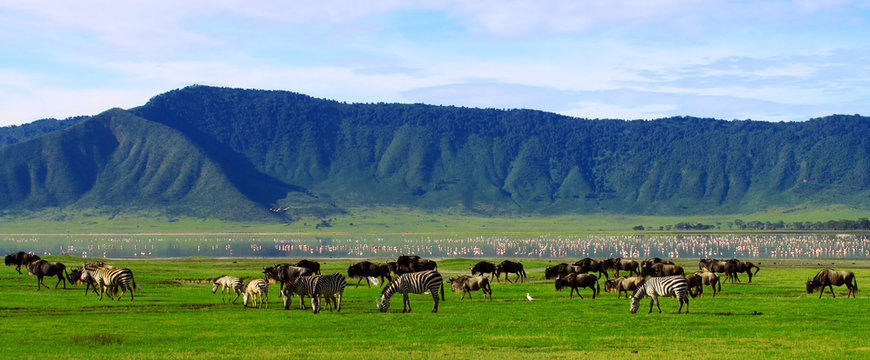
The Ngorongoro Crater: Africa's "Garden of Eden"
Located in northern Tanzania, the Ngorongoro Crater is the world’s largest inactive, unbroken, and unfilled volcanic caldera. Formed approximately 2 to 3 million years ago when a massive volcano exploded and collapsed on itself, it is now one of the most extraordinary natural enclosures on Earth.
Key Facts and Statistics
- Dimensions: The floor covers roughly 260 square kilometers (100 square miles) with a depth of about 610 meters (2,000 feet).
- Status: It is a UNESCO World Heritage Site and one of the Seven Natural Wonders of Africa.
- Climate: The crater floor remains temperate year-round, though the rim can get quite chilly and misty due to its high elevation.
A Self-Sustaining Ecosystem
The crater creates a unique "fishbowl" effect where most animals live within the walls year-round. It contains a diverse array of habitats:
- Lake Magadi: A shallow soda lake in the center, often pink with thousands of flamingos.
- Lerai Forest: A yellow-barked acacia forest favored by elephants and leopards.
- Gorigor Swamp: A haven for hippos and water birds.
Wildlife and Biodiversity
The Ngorongoro Crater boasts the highest density of big game in Africa. It is one of the best places on the continent to see the "Big Five" in a single day:
- Black Rhino: One of the few places where this critically endangered species is relatively easy to spot.
- Lions: Home to a dense population, though they are genetically isolated.
- Elephants: Primarily large "tusker" bulls roam the floor.
- Leopards: Usually found lurking in the trees along the rim or in the Lerai Forest.
- Buffalo: Large herds are common across the grasslands.
Note: Interestingly, you will not find giraffes inside the crater. It is believed the steep walls are too difficult for them to navigate, or the specific acacia trees they prefer are not abundant enough on the floor.
Human History and Coexistence
The area is part of the Ngorongoro Conservation Area (NCA), which differs from a National Park because it allows for multiple land use. The semi-nomadic Maasai people live within the conservation area, grazing their cattle alongside the wildlife, maintaining a traditional lifestyle that has existed for centuries.